Wednesday, October 27th, 2010

PayPal Launches a Mobile Payment System

Tags: alternative payment methods, mobile credit card processing

PayPal Launches a Mobile Payment SystemPayPal unveiled on Tuesday a new mobile payment system, called Mobile Express Checkout. The announcement was made at PayPal’s Innovate 2010 developers conference in San Francisco.


Mobile Express Checkout enables customers to complete purchases and check out of participating mobile e-commerce websites from their phones. The process goes through three stages:

  1. When ready to complete the purchase, the customer clicks a “Checkout with PayPal” link on the mobile website or in a SMS text message.
  2. The customer is transferred to PayPal’s website and asked to log into his or her account and make the payment, much as they would do from their PC.
  3. The customer is taken back to the merchant’s website to complete the transaction.


According to PayPal, merchants who have beta-tested the new service, including Nike and Foot Locker, have reported double-digit sales growth on their mobile stores after adding the feature.


Mobile Express Checkout currently only allows customers to check out with their PayPal accounts, however the company said that in 2011 it will enable merchants to accept credit cards directly. This feature will be possible through PayPal’s partnership with VeriFone.


In another product announcement at the conference, VeriFone introduced its PAYware Mobile card encryption sleeve for iPhone that will now accommodate PayPal payments as well as traditional credit card transactions. PAYware supports PayPal’s Bump technology that enables iPhone users to tap their phones together and transfer money between their accounts.


The mobile payment space has been buzzing with activity for many months now, with start-ups with names like Square, Boku, Mophie and Venmo seemingly gaining advantage over the established players. Just a couple of days ago Square, the creation of Twitter co-founder Jack Dorsey, officially went live after months of beta testing. The company said that they have already shipped 50,000 credit card readers to users.


Moreover, PayPal is being attacked by start-ups on fronts much closer to its core business. WePay, for example, has taken aim at what the young company has identified as a niche neglected by PayPal: enabling groups of users to collect and track money for bachelor parties, sporting events, donations, etc. They have even managed to convince one of PayPal’s co-founders – Max Levchin – to invest in their project.


Two other start-ups – Popmoney and ZashPay – have focused on simplifying the funding process, an issue PayPal merchants have long complained about. ZashPay, for example, facilitates the direct transfers of funds between senders and recipients, without holding on to the money for any length of time.


The new PayPal announcements clearly indicate that the payment giant is determined to make its presence felt in the nascent mobile payments market, which it expects to generate $700 million for the company in 2010, up from $141 million in 2009.


Accept card payments quickly and safely


FREE Authorize.Net Gateway and Lower Processing RatesAccept online payments via credit and debit cards and electronic checks at the lowest processing costs. You will get:


  • Free merchant account and Authorize.Net gateway set-up.
  • No monthly merchant account or gateway fees.


FREE Authorize.Net Gateway and Lower Processing Rates

Monday, October 25th, 2010

Mobile Credit Card Payment Service Square Goes Live

Tags: alternative payment methods, mobile credit card processing

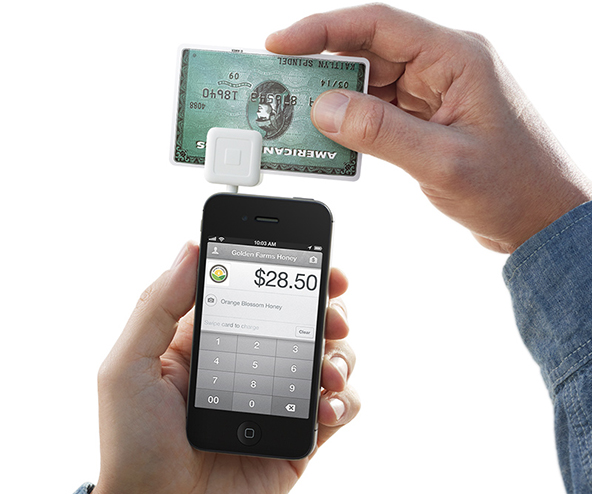
Mobile Credit Card Payment Service Square Goes Live“The doors are (finally) open @Square & we’re going big,” announced Twitter co-founder Jack Dorsey with a tweet. His latest project enables users to plug a small square (hence the name) credit card reader into their smart phone and accept credit cards for payment.


Square has been tested quite expansively since the service’s tests first began several months ago. According to USA Today’s Jon Swartz, about 50,000 Square readers were shipped to users, “ranging from coffee shops and pizza deliverers to doctors and piano teachers,” during the testing phase.


The Square credit card transaction process is quite simple. A buyer swipes his credit card through the reader and signs the sales receipt on the smart phone’s touch screen. A photo of the card’s true owner appears on the screen and, if it’s the right person, the seller taps a button and the transaction goes through.


Square also enables users to “generate email and SMS receipts for cash and card payments, maintain frequently sold items, calculate sales tax, and effortlessly manage and visualize all the money you take with an intuitive web-based interface,” according to the company.


There were reports, however, that things didn’t always go as smoothly as advertised. CNET’s Caroline McCarthy, for example, reported in February that during her tests the “credit card reader didn’t always read swipes and the software can be slow.”


Currently Square is available on iPhones, including now on iPhone 4, iPads, iPod Touches and some Androids, including the Droid, Droid X, Nexus One and Galaxy S. One smart phone conspicuously missing from this line-up is RIM’s BlackBerry and there is a good reason for it: most BlackBerry models lack a touch screen, which Square requires to enable buyers to sign the transaction receipt.


Square ships the card reader to approved users for free and charges 2.75% + $0.15 of the transaction’s amount, with no monthly charges or set-up fees. No long-term contract is required.


Now, compared to traditional credit card processing service providers, Square’s pricing is quite steep. A typical rate for retailers accepting credit cards in person nowadays is 1.65% + $0.20 of the transaction amount. True, there often is a monthly fee of about $10 or so, however some processors charge no such fees if the merchant generates a certain minimum of transactions.


But should Square be compared with traditional payment processors? Is Dorsey actually competing with the established players in our industry? The answer is obvious and it is “no, he does not.”


Dorsey is not targeting your local convenience or liquor store (although he would certainly ship them a reader if they requested one). No, Square is aiming at individuals who may need to accept a payment for a Craigslist’s sale or to split up a restaurant bill with friends once a month. This is a group that is not anywhere near the radar screen of traditional processors.


Square’s competitors are actually other start-ups, such as Boku, iCharge, Swipe It and Mophie, to name just a few and hardly a week goes by without us hearing of a new start-up entering the fray. In the words of Morgan Stanley analyst Adam Frisch, as quoted by USA Today’s Jon Swartz:

“The market is so nascent and fragmented, new technologies that pop up in it are expanding the reach of the market”.


Accept card payments quickly and safely


FREE Authorize.Net Gateway and Lower Processing RatesAccept online payments via credit and debit cards and electronic checks at the lowest processing costs. You will get:


  • Free merchant account and Authorize.Net gateway set-up.
  • No monthly merchant account or gateway fees.


FREE Authorize.Net Gateway and Lower Processing Rates

Friday, October 22nd, 2010

Mobile Payment Company Hopes to Make Text Donations Mainstream

Tags: alternative payment methods, mobile credit card processing

Mobile Payment Company Hopes to Make Text Donations MainstreamRemember the ads asking you to donate $5 to help the victims of the Haiti earthquake in the aftermath of the catastrophe? All you had to do was send a text message to a 5-digit number. Now a mobile payment company called Obopay has partnered with Benevity, a non-profit that describes its activities as ‘”social entrepreneurship”, “entrepreneurial philanthropy” or “creative capitalism”‘ to offer a service they hope will streamline the process.


The partners will allow any charity that is registered in the United States to create an account and select a keyword. Donors will then make donations by texting the keyword to a shortcode number that is assigned to the charity by Obopay during the registration process.


For example, by texting “GORILLA” to 48510, a consumer can donate to the Conservation Through Public Health and support gorilla conservation in Africa. Texting “KIDS” to the same number will send a donation to support children’s charities in the California Bay Area, including YMCA of San Francisco, East Palo Alto Kids Foundation, etc.


Once a donor has texted the charity keyword, he or she is taken to a mobile payment site to complete the donation and receive a tax receipts. Unlike the Haiti donation campaign, the new service allows consumers to donate in much larger amounts, “up to hundreds of dollars,” according to the press release. The partners claim that non-profits will be getting a much faster access to the donations, “compared to other text-to-donate offerings that have been limited to $5 and $10 amounts and have taken over 90 days.” However, the press release does not specify just how fast this access will be.


Carol Realini, CEO of Obopay, defines the problem her company, in partnership with Benevity, is trying to resolve:

Crisis relief to Haiti put mobile donations on the map in America, but until now mobile donations have only been available for a handful of the largest non-profits and executed through carrier billing, which places limits on the amounts that can be donated and delays the receipt of funds.


However, she is rather vague in describing how her company’s new platform will make things better:

Our new text-to-donate offering, which can work with the Benevity micro-donation platform as its giving engine, meets these needs and meaningfully expands the market and speed for making and accepting mobile donations.


Overall, the new service sounds promising, although it would be helpful if we had more details on the program. And non-profits do need help collecting donations. At present, the payment card industry classifies charities as high-risk, making it harder for them to set up merchant accounts and accept credit card payments the traditional way. There are legitimate reasons for this classification, not least among them the statutory obligation for processing banks to ensure that donations are not used for funding terrorist or other illegal causes. Hopefully, Obopay and Benevity will help streamline the payment-collection process for legitimate charities, while still keeping the bad guys at bay.


Accept card payments quickly and safely


FREE Authorize.Net Gateway and Lower Processing RatesAccept online payments via credit and debit cards and electronic checks at the lowest processing costs. You will get:


  • Free merchant account and Authorize.Net gateway set-up.
  • No monthly merchant account or gateway fees.


FREE Authorize.Net Gateway and Lower Processing Rates

Tuesday, October 19th, 2010

iPhone 5 to Act as a Debit Card

Tags: alternative payment methods, mobile credit card processing

The blogosphere has been buzzing with rumors about the possible incorporation of near field communication (NFC) technology into the next iteration of Apple’s iPhone. NFC-enabled mobile phones can be used for making payments using credit or debit card information that is pre-stored on the phone by swiping it by a NFC-equipped reader at participating retailers.


Actually, the idea is not exactly revolutionary. In fact, there have already been several big announcements this year about NFC-related pilot projects. The biggest one is probably the one involving three large mobile network carriers (Verizon, AT&T and T-Mobile), a huge bank (Barclays) and the fourth-biggest U.S. credit card payment network (Discover). The quintet is planning to use NFC technology to enable users to make payments by linking their mobile phone accounts to a Discover credit card account.


The NFC technology uses frequency that allows data transmission between enabled devices within a range of less than 8 in., which limits the risk exposure to threats from hackers.


Now, let’s take a look at what Apple is rumored to be working on. According to Finextra:

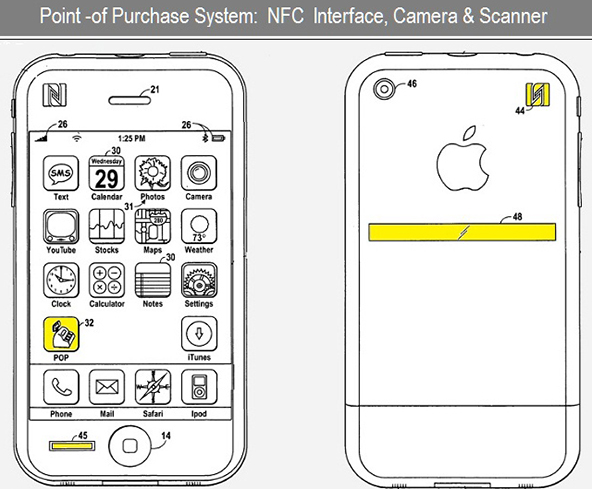
…Apple is working on an NFC-enabled phone, and given their recent hires in the space, it is assumed that the iPhone 5 will be the platform for this change. So how will Apple’s NFC-enabled iPhone 5 work? We know a few things about the likely capability of the phone based on the patents issued by Apple. Firstly, the payment application will be a core app integrated into the phone, there will be a biometric strip (presumably enabling fingerprint authentication) and the phone will ostensibly work just like an EMV-chip credit card.

We know that the primary payment app will work as an interface to your bank or credit card company as you need it to.


Finextra’s piece goes on to suggest that Steve Jobs and company would then take it a step further and actually turn the iPhone 5 into an Apple-backed debit card by providing users with “stored value” through its iTunes store. In effect, Apple would become a bank.


iPhone 5 to Act as a Debit Card

Apple's NFC patent for the iPhone


While this is by no means an improbable scenario, is it really inevitable? Would Apple really want to become a bank? Even if it does, would it be willing to put up with all the additional scrutiny and extra regulatory burden?


Before answering these questions, we may want to first take a look at other successful retailers’ recent ventures into banking. Actually, the story of the biggest of them all – Wal-Mart – may suffice. For years now the retail giant has been going through a long, tortuous and, as of yet, unsuccessful process in its quest to become a bank. To this day all financial services offered by Wal-Mart are underwritten by a financial institution. It doesn’t seem likely that Apple would choose to go the same route.


The added regulatory scrutiny was no doubt among the biggest reasons Verizon, AT&T and T-Mobile chose to partner with financial institutions, rather than go it alone. Technically, they could have easily done it. The billing infrastructure is already in place and their customer service staff is used to handling customer billing inquiries. Yet, the carriers seem to have decided that staying within their core competency would be the more prudent way to go. Apple would probably come to the same conclusion.


Accept card payments quickly and safely


FREE Authorize.Net Gateway and Lower Processing RatesAccept online payments via credit and debit cards and electronic checks at the lowest processing costs. You will get:


  • Free merchant account and Authorize.Net gateway set-up.
  • No monthly merchant account or gateway fees.


FREE Authorize.Net Gateway and Lower Processing Rates

Saturday, October 2nd, 2010

Credit Card Companies Beef Up their E-Commerce Presence

Tags: alternative payment methods, American Express, card issuers, Discover, e-commerce, MasterCard, mobile credit card processing, Visa

Credit Card Companies Beef Up their E-Commerce PresenceCredit card associations (Visa and MasterCard) and companies (American Express and Discover) are not exactly famous for their flexibility and nimbleness in adjusting to fast-changing circumstances. In fact, they are rather conservatively run institutions that would like nothing better than for everything to remain static, so that they can keep on making money the way they always have. Come to think of it, we should not be too hard on them, as most of us change our ways of doing things only when we are forced to do so.


Well, it seems like changes are being forced on the credit card behemoths and they are reluctantly beginning to expand their offerings and beef up existing ones. Oh, and they are opening up their wallets too, big time.


The e-commerce is where the current events are unfolding and DMNews.com’s Alex Palmer has a great article about the latest developments. As usual, young, aggressive competitors have spurred the incumbents into action. PayPal and Google Checkout have gradually evolved from smallish blips on Visa’s and MasterCard’s radar screens into major players on the e-commerce front.


“The card companies have to make sure that they are relevant. These guys are not oblivious to the fact that new entrants have taken a bite out of the purchase volume,” said Allen Weinberg, payments consultant for Glenbrook Partners, a payment strategy consulting firm, as quoted by Palmer.


Palmer goes on to list some of the old guard’ recent moves in response of the threat posed by the upstarts:

Visa is moving aggressively to promote, and add to, its e-commerce capabilities. The company recently initiated a marketing program for its Rightcliq online shopping service. The platform not only allows customers to store their payment card numbers with the service, even for competing cards, but also offers to track order delivery status.


Visa also acquired CyberSource, the online fraud prevention and payment gateway, this year.

American Express announced last month that members will be able to use Membership Rewards points toward purchases on Amazon.com. Discover Financial Services said it will collaborate with Firethorn Holdings on the soon-to-be-released Swagg mobile gift card application, which will allow shoppers to purchase, customize and exchange gift cards on their smartphones.


MasterCard bought UK-based payment services company DataCash Group for $520 million in August to expand its online commerce business. It also launched the MasterCard MarketPlace, a discount site for card members, with e-commerce company NextJump.


It has to be pointed out, however, that although the newcomers pose a legitimate threat to the establishment, they are by no means total outsiders. In order for anyone, including PayPal and Google Checkout, to accept Visa and MasterCard cards, for example, they have to have a relationship with a processing bank that is a member of Visa and MasterCard. The processing bank “acquires” its client’s transactions and submits them for settlement with the credit card associations, all the while collecting its fees, as do the card issuer and the associations. Now, neither PayPal nor Google Checkout is a bank in the U.S., so they don’t even keep the processor’s fees for themselves, which are far lower than the issuer’s.


From a payment processor’s point of view, PayPal and Google Checkout look like oversized e-commerce businesses. What makes it slightly less obvious to the casual observer is the type of service they provide. Instead of downloadable software, the pair provides a means for payment on the internet.


But that is the present. The world of the e-commerce, and especially mobile, payments is evolving incredibly fast and in the not-too-distant future we may see payment services that completely circumvent the Visas of the world. We’ve actually already seen a glimpse of how this may look. A couple of months ago Verizon, AT&T and T-Mobile announced a partnership with Discover and Barclays to enable their customers to use their cell phones as credit cards. This is a potentially huge venture and Visa and MasterCard are out of the picture. True, a credit card company (Discover) and a major bank (Barclays) are in it, but it is not hard to imagine smaller-scale operations that completely circumvent the established players’ networks. Given time, some of these newcomers can grow sufficiently to change the face of the industry beyond recognition. This is exactly what keeps Visa and MasterCard on their toes.


Accept card payments quickly and safely


FREE Authorize.Net Gateway and Lower Processing RatesAccept online payments via credit and debit cards and electronic checks at the lowest processing costs. You will get:


  • Free merchant account and Authorize.Net gateway set-up.
  • No monthly merchant account or gateway fees.


FREE Authorize.Net Gateway and Lower Processing Rates