Monday, August 30th, 2010

Intuit Teams up with Mophie to Offer Credit Card Processing for iPhone

Tags: alternative payment methods, credit card acceptance, mobile credit card processing

Intuit Teams up with Mophie to Offer Credit Card Processing for iPhoneThe mobile payments market has just become even more crowded. QuickBooks maker Intuit and mophie, creator of the JuicePack battery for iPhone, have launched the Complete Credit Card Solution, which enables iPhone users to accept credit card payments, the companies announced. The product is now available in Apple stores and will soon be available online as well.


We have seen a number of credit card processing product releases for smart phones and specifically for the iPhone in the past few months, most notably Square, but also MasterCard MoneySend, Visa payWave and Swipe It, among others. In fact, Mophie first announced that it was planning to start producing credit card readers for the iPhone back in December of last year.


The Complete Credit Card Solution works by integrating “Intuit’s GoPayment credit card processing app and quick-to-activate merchant account with the mophie marketplace iPhone credit card reader,” according to Intuit. Users can have the service up and running “in as few as 15 minutes.”


Unlike previous announcements, this one comes with a fairly detailed pricing list, which is worth taking a close look at:

The Complete Credit Card Solution from Intuit and mophie is available for the iPhone 3G and 3GS for $179.95 at Apple Retail Stores and soon on Apple.com.

GoPayment, including the Intuit merchant account, offers competitive pricing at $12.95 a month, a 1.7 to 3.7 percent discount rate and $0.30 to $0.34 per transaction fee. There are no long-term contracts, cancellation, gateway or set-up fees, and one account can enable up to 50 users.


First, it should be noted that mophie’s card reader enables the acceptance of “card-present” transactions, which get the lowest processing rates from Visa and MasterCard. Now let’s break down the pricing:

  • Cost of product – $179.95. This is essentially the cost of uploading the GoPayment app to an iPhone. It seems a bit excessive, as similar uploads to point-of-sale (POS) terminals are typically provided for free. True, you don’t have to actually buy a terminal, but it’s still high.
  • Merchant account fee – $12.95. This fee is comparable to what other merchant account providers charge for keeping the account open.
  • Discount rate – 1.7 – 3.7 percent. Most processors now charge qualified rates of around 1.65 percent and non-qualified of 3.25 – 3.50 percent, so GoPayment is priced higher than the average.
  • Per-transaction fee – $0.30 – $0.34. Here is the most substantial pricing difference. The average qualified rate for card-present transactions in the industry is currently $0.20, 50 percent less than what GoPayment charges. The average non-qualified rate in the industry is $0.30.
  • Other fees. Most processors no longer charge set-up fees, and a gateway fee is not associated with card-present accounts. GoPayment does offer a no-contract service, however the user must pay $179.95 upfront to enroll.


Overall, the service does seem a bit pricey and it is unlikely that it will be adopted by consumers who may just want to have another option for splitting up a restaurant bill with friends. The more likely adopters would be the small business or self-employed types of users who need a way for accepting card payments on the go, e.g. at a trade show or at a customer’s location. These types of users, however, typically only need the service intermittently, which makes them highly cost-sensitive and may cause them to balk at paying a high upfront fee, in addition to the monthly fee.


We’ll have to wait and see how well Intuit and mophie will deal with fraud-prevention and reliability issues, which have plagued previous entrants into the mobile payments market, including Square.


Whether this particular venture will succeed or not, however, the concept of using smart phones for processing payments will eventually be proven right. After all, wireless credit card processing terminals use the same signals to transmit transaction information that cell phones use to communicate voice and data. Why not combine them?


Accept card payments quickly and safely


FREE Authorize.Net Gateway and Lower Processing RatesAccept online payments via credit and debit cards and electronic checks at the lowest processing costs. You will get:


  • Free merchant account and Authorize.Net gateway set-up.
  • No monthly merchant account or gateway fees.


FREE Authorize.Net Gateway and Lower Processing Rates

Friday, August 27th, 2010

Verizon Backs a Loyalty Card Startup

Tags: alternative payment methods, mobile credit card processing

Verizon Backs a Loyalty Card StartupThis past weekend we learned from the WSJ that a loyalty card startup, called CardStar, has attracted the attention of Verizon. The carrier has invested $400,000 in the Boston-based company, which although it isn’t much, provides yet another indication that the major U.S. cell phone operators are becoming increasingly interested in the potential of the mobile payment technology to provide an additional, and potentially major, source of revenue.


Just a couple of weeks ago, another Verizon mobile payment venture made a much bigger splash when it was announced that the carrier was teaming up with rivals AT&T and T-Mobile, payment processor Discover and British bank Barclays to enable consumers to make payments at participating merchants using their cell phones.


The CardStar project is not nearly as ambitious as the other one, but it does offer a look into how retailers may be managing their loyalty programs in the near future. It is not immediately clear how Verizon will utilize the service to generate revenue, but it is a safe bet that they are seeing CardStar as part of a larger mobile payment picture.


CardStar has developed mobile apps for the iPhone, Android, and BlackBerry, which allow users to consolidate their loyalty and membership cards in one place. The idea is that you won’t have to carry all these small pieces of plastic on you anymore. Instead, the merchant can scan the card’s barcode from the screen of the user’s phone.


What makes CardStar attractive to retailers is that they can run promotions and loyalty programs through the startup’s back end. They can load offers, coupons and incentives directly into the application. Offers can be customized using a geotargeting feature.


CardStar claims to have signed up more than 2,000 merchants already, both large and small. “We have about 30 competitors out there, but all 30 put together don’t have the numbers [of users] that we have,” boasts CardStar’s CEO Andy Miller, as quoted by the WSJ.


Miller says that CardStar has 700,000 unique users and that number is sure to grow. On top of the convenience of storing all these loyalty cards in your phone, you won’t have to clip coupons anymore.


CardStar and its competitors offer shoppers convenience and retailers opportunities, but they are also helping us see the future of plastic cards, or the lack of it. Within a few short years, most of us will be using our cell phones to identify ourselves to retailers, communicate with them, find the best prices in our area or online, and pay for our purchases.


Accept card payments quickly and safely


FREE Retail Merchant Account and Lower Processing RatesAccept credit and debit card payments at the lowest processing costs. You will get:


  • Free merchant account set-up.
  • No fixed monthly fees.
  • 24 / 7 customer support.


FREE Retail Merchant Account and Lower Processing Rates

Monday, August 9th, 2010

Will Cell Phones Replace Credit Cards?

Tags: alternative payment methods, Discover, mobile credit card processing

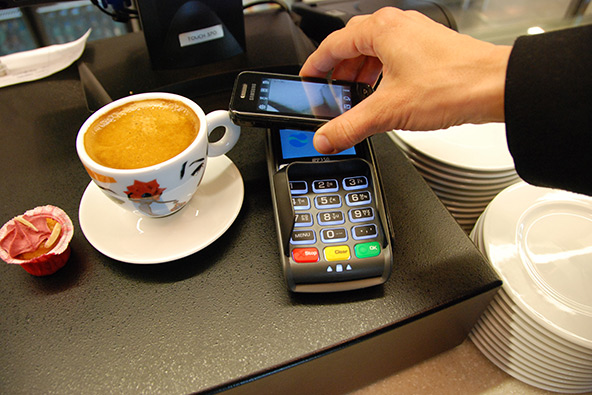
Will Cell Phones Replace Credit Cards?Reports of new gadgets and services with the potential to replace credit cards are being released at an ever increasing rate. The latest one cites a new venture, teaming up three mobile phone carriers, a credit card processing company and a large bank. The participants – Verizon, AT&T, T-Mobile, Discover and Barclays – are planning to use near field communication (NFC) technology to enable consumers to make payments at participating merchants using their NFC-enabled cell phones. In essence, users will be making payments by waving a cell phone by a wireless device, which would “read” the user’s account information stores on the phone, much as a point-of-sale (POS) terminal does when you swipe your card through it. The only difference would be that you would be using not a credit card but a phone.


Does that mean that cell phones are on the verge of replacing credit cards? No, it does not! What the carriers, with help from Discover and Barclays, are doing is nothing more than developing one more, although potentially novel, mechanism for processing credit card payments, to do just what a POS terminal or a payment gateway does.


Let’s take a look at how the service will work. When a participating consumer waves her phone to make a payment at a NFC-enabled checkout, payment information will be sent from the phone to the merchant. Such information would include the customer’s name, address, account number, payment amount, date and time. The merchant will then transmit the information to Discover and request transaction authorization. Upon approval, a sales receipt will be printed out, the customer will sign it and the transaction will be complete.


If we leave the technical details aside, this is exactly the way a credit card transaction is processed. I should say “any other credit card transaction,” because that’s exactly what it is.


The key point is that Discover will be processing the payments, which leads to two obvious conclusions:

  • Users will have to have Discover accounts. In addition to her account with the mobile carrier, our user will have to have one with Discover, so that the credit card company can:
    • Recognize the customer.
    • Verify the validity of the provided information.
    • Check for fraud.
    • Debit the correct account.
  • Discover will be charging processing fees for the service. These fees are paid by the merchants, not by their customers.


So how should we call an account with a credit card company that we can tap into at any time to pay for products and services in transactions that cost the merchant a percentage of the sale’s amount?


The relationship between a credit card company and a non-financial organization is nothing new, either. Discover, as well as its rivals, has a long track record of issuing branded credit cards, under the name of retailers, airlines, various service providers, etc. This particular venture may offer a new feature or two but it will not introduce anything revolutionary.


Learn how to lower your card acceptance cost


Payment Card Acceptance KitLearn how to accept credit and debit cards at the lowest processing costs. The Payment Card Acceptance kit contains a video and an e-book:


  • Video – Card Acceptance Best Practices for Lowest Processing Costs (18 min).
  • E-Book – Payment Card Acceptance Guide (19 pages).


Payment Card Acceptance Kit